
I build the software a company runs on every day.
Production systems, excise stamp records, HR and integrations. Not slide decks and not prototypes: three systems I have built, two of them in daily use on the production floor and in HR, and the third being rolled out. The oldest one has been running a manufacturing plant day to day since May 2026.
What I do
I specialise in the places where off-the-shelf software runs out: an unusual process, record-keeping obligations, equipment on the shop floor and data scattered across spreadsheets.
Production systems and MES
Planning, recipes, inventory, cost accounting and operator panels on the shop floor. One system instead of several disconnected tools.
Read more →Excise stamp records
Excise stamps, daily summaries, documents for the tax office and unbroken numbering. An area where a mistake costs more than the software.
Read more →HR and scheduling
Working time, shift schedules, attendance, leave requests and payroll inputs. Things that usually live in spreadsheets and in the heads of a few people.
Read more →Integrations and automation
Connections to the parent system, carriers and devices on the shop floor. Data entered once, available everywhere.
Read more →I also write small tools for businesses: calculators, file and image processing, data checks. A few of them are free to download.
The same order, two ways to run it
On the left, a spreadsheet where data has to be retyped and then checked in case someone has already changed it. On the right, the same working day in the system. Move the slider.
| B | C | E | L | M | N | |
|---|---|---|---|---|---|---|
| PRODUCT | VOL. | produced | base in system | ml produced | in stock | |
| 14 | SERIES TERRA 10 ML 20 MG | 10 | 887 | 0,78 | 8870 | 946 |
| 15 | SERIES BETA 7 ML | 7 | 339 | 0,78 | 2373 | 110 |
| 16 | SERIES DELTA 10 ML 20 MG | 10 | 1073 | 0,09 | 10730 | 378 |
| 17 | SERIES NOVA 10 ML 20 MG | 10 | 1052 | 0,90 | 10520 | 709 |
| 18 | SERIES VEGA 10 ML 20 MG | 10 | 886 | 0,25 | 8860 | 279 |
| 19 | SERIES OMEGA 10 ML 20 MG | 10 | 886 | 6,55 | 8860 | 0 |
| 20 | SERIES ALFA 10 ML 20 MG | 10 | 1073 | 0,08 | 10730 | 899 |
| 21 | 0 | #N/A | #N/A | |||
| 22 | 0 | #N/A | #N/A | |||
| 23 | auto total | 6196 | 60943 |
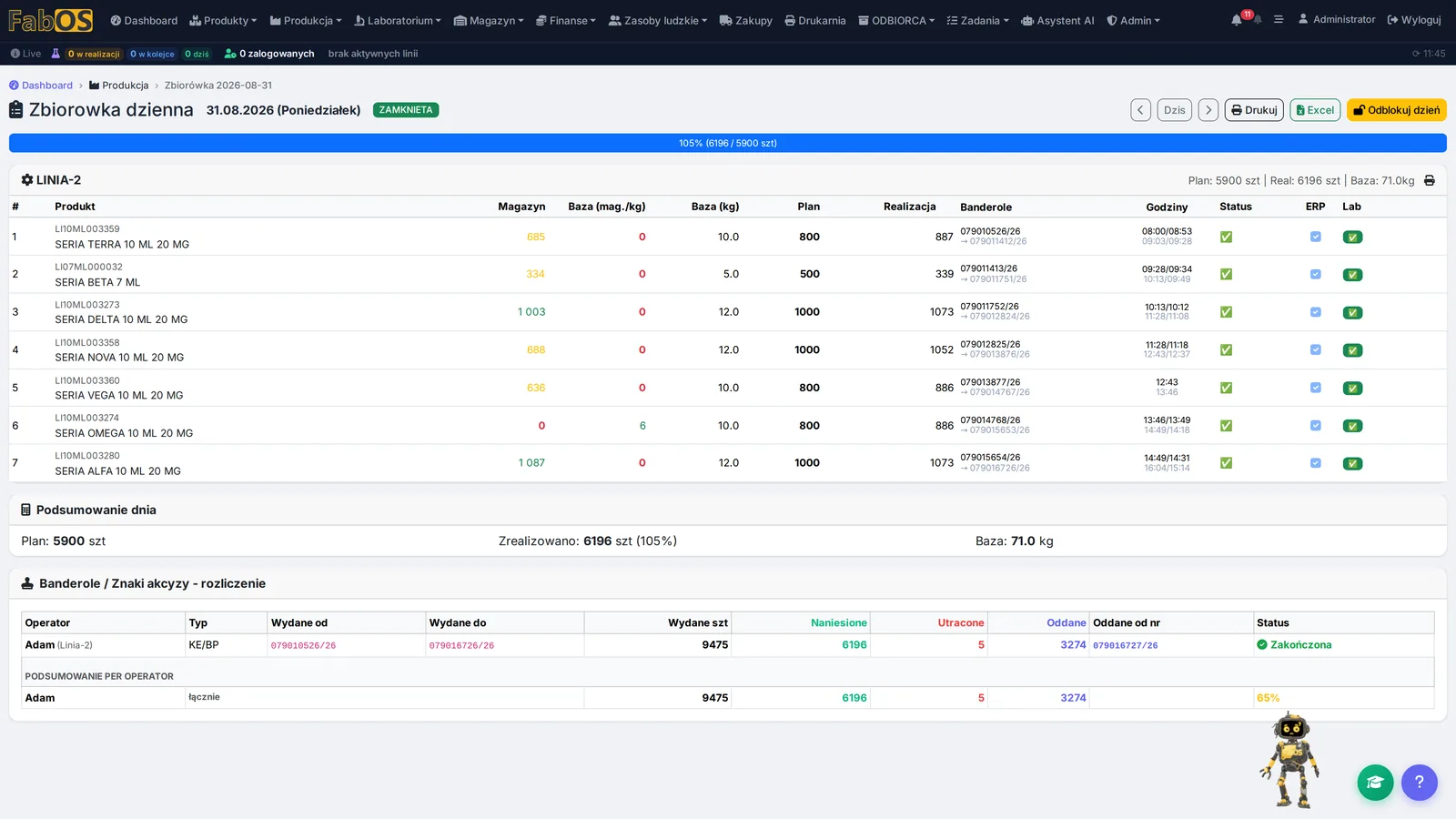
Drag the slider or use the arrow keys.
What runs in production
Each of these is used every day by real people in a real company. The numbers come from live databases, not from estimates.
FabOS MES
Runs a manufacturing plant: planning, recipes, inventory, excise records, operator panels on the shop floor and labour accounting. Built from scratch and developed while the plant kept working normally, without stopping production.
58 modules · over 1000 screens and data exchange endpointsHRPanel
Working time records, shift schedules, attendance, leave requests and payroll inputs. Built so that many companies can work in one installation, each in its own isolated data area.
in production use · a second company in a trial rolloutB2B shop
Orders from trade customers with individual price lists, linked directly to the warehouse and the production system. Being rolled out; full launch is waiting for the parent system to open its interface, which is a decision outside the plant.
integration with the parent systemWho it makes sense for
Not for everyone. Below are the situations where made-to-measure software pays for itself faster than an off-the-shelf system with a subscription.
A manufacturer whose process does not fit off-the-shelf software
Recipes with variants, semi-finished products, changeovers, batch work and quality control done your own way. An off-the-shelf system either cannot handle it, or handles it by changing how the whole shop floor works.
A company with record-keeping obligations
Excise goods, excise stamps, records required by law, documents for the tax office. This is not about convenience, it is about records that match down to the last unit and stand up to an inspection.
A company that has grown a dozen spreadsheets
Every department has its own file, data is retyped by hand between them, and the management report takes a working day. This is usually the cheapest moment for a change, because the process is already thought through and only the tool is missing.
A company that has an ERP and wants to complement it, not replace it
The sales and inventory system stays where it is good: invoices and stock levels. The rest, meaning the shop floor, HR and cost accounting, gets a tool that fits it and exchanges data with the ERP automatically.
How I work
Process first, software second
Before anything gets built, I spend time where the work actually happens. Most failed implementations start from a process description that does not match reality.
Small steps in a running business
I do not stop production for an implementation. The system goes in stages, starting with what hurts most, and collects real data from the first week.
A ready core, fitted modules
Off-the-shelf systems expect the company to adapt to the software. FabOS has a working core, and I fit the rest to your process, because the process is usually well thought through, and changing it costs more than adding a missing module.
I stay after go-live
A company changes every month: new products, new requirements, new machines. A system that nobody develops becomes the bottleneck again within a year.
Frequently asked questions
How much does a FabOS implementation cost?
The quote comes after I have looked at the process, not over the phone. If your needs are covered by the existing core and ready modules, implementation costs much less than writing a system from scratch, because I only add what is missing. I work in stages: each stage has its own scope and its own price.
Can a new system connect to what we already have?
Yes, and that is exactly how I work. The systems I have built exchange data with the sales and inventory system, with carriers and with devices on the shop floor: scales, label printers and barcode scanners. A production system will not replace your ERP and is not meant to. They answer different questions: the ERP knows what was ordered, invoiced and is in stock, the production system knows what happens on the shop floor in between. They should exchange data, not compete.
Do you work remotely?
Development and support are remote, but the process assessment happens on site. A day on the shop floor or in the office usually changes the assumptions more than a week of meetings, so I do not move that stage to video calls.
Contact
If something in your company runs on spreadsheets and paper but should run on its own, get in touch. The first conversation costs nothing and does not end with a quote sent blind.
The controller of the data from this form is Emanuel Maciołek Fabria, Polish tax ID (NIP) 6782631030. The data is used only to reply to your message; it does not go to a newsletter and is never sold. You can have it deleted at any time by writing to kontakt@fabria.pl. Details: privacy notice.